Friday, 13 March 2015

The three Modes of Material Nature

 
The 14th Chapter of Bhagavad Gita contains a detailed description of three modes of material nature, how a spirit soul is influenced by these modes, what are the symptoms of these modes, how they influence us and finally, how to get freedom from these modes by practice of Bhakti or devotional service. Thus, the three modes Goodness, passion and ignorance can be compared to three primary colours Red, Yellow and blue. By combining these three colours, an artist can create thousands of combinations. Similarly, by the combination of these three modes 8, 40,000 species of life forms are created.

Bhagavad Gita 14.18:
urdhvam gacchanti sattva-stha
madhye tisthanti rajasah
jaghanya-guna-vrtti-stha
adho gacchanti tamasha
Those situated in the mode of goodness gradually go upward to the higher planets; those in the mode of passion live on the earthly planets; and those in the abominable mode of ignorance go down to the hellish worlds. (Translation by Srila Prabhupad)

In this verse, Lord Krishna is explaining the future destination of a Soul based on the type of material mode a living being is situated. One in the mode of goodness will progress to the higher regions and higher birth like that of a demigod or a place in heaven etc. The one who is in the mode of passion will stay in the earthy region and the one in the mode of ignorance will gradually go downward into the lower regions of the hellish world.
The three modes of material nature are like chains, which bind the conditioned soul to the material world. Thus, we can compare the Mode of Goodness to Chain made of gold, passion to a silver chain and ignorance to that of an iron chain. Unless one transcends these three modes of material nature, a Soul will not become free and get himself away from this cycle of repeated birth and death. Thus, even though the mode of goodness is conducive to , as explained in this verse – going upwards or for a higher form of life, unless one practices devotional service and elevates himself to the mode of Suddha Satva; Pure Goodness, there is danger of one falling down from the higher level to the lower level. It was also explained by Lord Krishna that these three material modes of nature of always competing within an individual to gain supremacy. Thus, a person for some time can be in the mode of goodness and immediately get into the mode of passion or ignorance. Thus, a person in the mode of goodness gets up in the morning, worship demigods in the house, on way to work may make a donation for Save the Children org, in the office become passionate and start arguing with colleagues, in the mode of ignorance come back home tired, consume alcohol and fall into deep sleep completely oblivious to the world.

This brings us down to the point of different factors that affect how a soul is influenced by the three modes of material nature, which are listed below
1.Agama – which Sastras we hear. Hearing is the powerful tool that can influence our nature. The sound makes up our thoughts and our thoughts make up, what we are. There are shastras written for people in the mode of goodness, passion and ignorance. Thus, hearing the right Shastra like Bhagavad Gita and Srimad Bhagavatham will purify our consciousness and help one to get into the mode of goodness and ultimately in to pure goodness.
2. Apah – The water we drink and the types of food we eat. Lord Krishna explains that there are foods in the mode of goodness which are fatty, juice and food in the mode of passion which are Spicy, hot and foods in the mode of ignorance which foul smell, putrid etc. Similarly, what we drink – pure water is better than a soft drink or a Beer. That’s why it was advised by Krishna to offer the food stuff which is in the mode of goodness and eat the remnants or the prasadam by which one will not incur any sin.
3. Praja – Our association. Association is infectious. It is rightly said - a man is known by the company he keeps. People resort to substance abuse or become alcoholic only because of bad association. So we need to be extremely careful while choosing our companions. We should seek company of those whose life is an emblem of purity and virtue. Such noble souls can easily transform our lives.
A south Indian poet called Yogi Vemana explains the value of right association Telugu is as below,
Veru purugu ceri vrukshambu ceracunu
cida purugu ceri cettu ceracu
kutsitundu ceri gunavantu ceracura
visvadabhirama vinura Vema !
Translation: - A root-worm infects the roots and destroys the entire tree. Termite infects and destroys the whole tree. Similarly a vile one spoils a virtuous person. Good company and association with wise people are essential for one to remain virtuous and to do good.
4. Desa – where we live. Place where one lives influences the person and for a particular mode to gain supremacy over others. For example, if a person lives in a city in a high rise apartment and thought the day he see only a concrete jungle, he naturally becomes passionate and workaholic always running to work, earn money etc.
5. Kala – the time of the day. It is said that Brahma Muhurtha or the time – 2 hrs before sunrise is excellent and conducive for meditation on the Lord and similarly the day time is for passion and night for ignorance.
6. Karma – Our activities, which means our daily routine of how we get up, what kind of work we do and how we earn our livelihood.
7. Janma – Our conditioning from birth which includes the environment we grew up, the way we are brought up in a family and the way we are taught to respond to situations.
8. Dhyana – Our thoughts. There is a saying in Vedas, which says “Yad Bhavam, Tad Bhavati” – You are what you think or your thoughts make up what kind of a person you are.
9. Mantras – what we chant. There are a number of Mantras some of which are used to worship demigods for some temporary benefits like Saraswati for studies, Ganesh for removal of obstacles etc. There are also mantra to worship the Supreme Lord Krishna and other purusha avatars like Narasimha, Rama etc. Each mantra is different and gives different results.
10. Samskaras – The varnasrama ceremonies we undergo which begin with impregnation and end with burial. For example, ceremonies like Garbhadhana samskara to beget a right child, determines what kind of Soul one attracts during the time of conception of child. These samskaras helps to purify the consciousness of a person which ultimately determines the results one receives.

So, two people are looking from a prison window and one is seeing the stars, sky and the moon, while the other person is watching all the filth, garbage and gutter down below. In life, we always hear people giving excuses, saying things like, I was not lucky, I did not get a chance or the time was not good but, what really makes the difference is ourselves. How we react to the different situations in life. That brings us to the point, why or how some people react differently. It’s because of the way we conduct our lives, put ourselves in the right direction and right mode.

The great philosopher Socrates at the age of 70 was sentenced to death and was asked to kill himself by drinking a cup of poison. In front of 500 spectators, when he drank the poison, his students asked him “Where shall we bury you?” His reply was, “firstly you have to find me to bury me”.

Monday, 9 March 2015

Chinese New Year - Year of Goat

Saw this impressive Dragon procession today in Swanston Street - Melbourne. I was told that this is a part of the celebration of Chinese New Year. As per Chinese calendar, this year is considered to be the year of Goat or associated with Goat. The actual New Year day, this year for Chinese was on Feb 19th.The 12 zodiac animals are: Rat, Ox, Tiger, Rabbit, Dragon, Snake, Horse, Goat, Monkey, Rooster, Dog, and Pig. So, depending on the Month and year you are born, you are associated with a Animal. There you go, I just found out that I am a Pig; that too a Gold Pig.What are you.?

 Interesting stuff, from one of the oldest cultures of the world.


Thursday, 5 March 2015

Gauranga - The Golden Avatara

Navadvip - A drawing of nine Islands

Today is the appearance day of Lord Krishna Chaitanya, also called as Gauranga the one whose complexion is that of golden colour. When you look up on the net, you get interesting and different descriptions about Lord Chaitanya. He is described as the greatest saint of 16th century in west Bengal, appeared in a place called Navadvip (Nine Islands).Some describe him as a great social reformer who fought against the Muslim rulers for freedom of practicing the Hindu religion. Some other name him as a pioneer of the Sankirtana movement - the congregational chanting and dancing of gods names. Some others describe him as the person who displayed the highest sentiments, ecstatic symptoms of love for Lord Krishna.
River Ganges, Just after the Sunset
However, one needs to go further we realise that Lord Chaitanya is none other than the Supreme Personality of Godhead, who took the form of a devotee to distribute the holy name and love of God more freely. Thus, Lord Chaitanya is the combined form of Lord Krishna and his dear most devotee Srimati Radharani. Not only, a number of Vedic scripture confirm this point, including the vedas and Srimad Bhagavatham, Chaitanya Charitamrita, Chaitanya Bhagavatha, Chaitanya  Mangala.
The incarnation of Lord Chaitanya is also called, Chana avatar or the hidden incarnation because, the Lord never allowed anyone to call him as god and would close his ears as soon as someone, calls him so.The reason for this is clearly explained in Chaitanya Charitamrita by Krishnadas Kaviraj gosvami, that this incarnation of Lord is to show and teach common people how to be a devotee of the Supreme Lord.
Lord Chaitanya introduced and  popularised the 16 syllable Mantra , “Hare Krishna Hare Krishna  Krishna Krishna Hare Hare, Hare Rama Hare Rama Rama Rama Hare Hare “, which is a mantra that can be chanted by anyone irrespective of caste, creed, sex or age and also, any time, place and circumstances.
I am posting some of the photographs from my last trip to Mayapur, two years ago.

Chaitanya Mahaprabhu at Simantadvipa.

Some Flash of thoughts

Strathearn-Otaki, New Zealand

I just came across this beautiful photo I took few months ago. The place was so nice, calm, serene and refreshing. And, the following thoughts came to my mind.
Everyone should take time to rewind, relax and introspect. See where you are going, what you want in life, what is happening with your life. Try to think of something higher other than, eating varieties of dishes, watching movies, playing video and mobile games, buying new gadgets, new mobiles. I have a friend who bought Iphone 5 and before buying, he was looking forward to it and after he brought, he didn't like it. Then, he sold it off for a lesser price and after selling it, he is now thinking maybe it would have been a better option to keep it and looks and works better than Iphone 4. Anyway, now he has his eyes on Iphone 6.
So the only way you can get off this Hedonic treadmill is to engage in higher pursuits by getting away from the crazy rat race. It is said that, People make more money, more money, see other doing it and continue making more money. It’s a Hedonic treadmill that people can’t get down from i.e. one Keeps walking just to stay in the same place.


Friday, 27 February 2015

Three questions - A short story by Leo Tolstoy

Here is an age old wonderful story. Bit, of a long one but, worth reading.
It once occurred to a certain king, that if he always knew the right time to begin everything; if he knew who were the right people to listen to, and whom to avoid; and, above all, if he always knew what was the most important thing to do, he would never fail in anything he might undertake.
And this thought having occurred to him, he had it proclaimed throughout his kingdom that he would give a great reward to any one who would teach him what was the right time for every action, and who were the most necessary people, and how he might know what was the most important thing to do.
And learned men came to the King, but they all answered his questions differently.
In reply to the first question, some said that to know the right time for every action, one must draw up in advance, a table of days, months and years, and must live strictly according to it. Only thus, said they, could everything be done at its proper time. Others declared that it was impossible to decide beforehand the right time for every action; but that, not letting oneself be absorbed in idle pastimes, one should always attend to all that was going on, and then do what was most needful. Others, again, said that however attentive the King might be to what was going on, it was impossible for one man to decide correctly the right time for every action, but that he should have a Council of wise men, who would help him to fix the proper time for everything.
But then again others said there were some things which could not wait to be laid before a Council, but about which one had at once to decide whether to undertake them or not. But in order to decide that, one must know beforehand what was going to happen. It is only magicians who know that; and, therefore, in order to know the right time for every action, one must consult magicians.
Equally various were the answers to the second question. Some said, the people the King most needed were his Councillors; others, the priests; others, the doctors; while some said the warriors were the most necessary.
To the third question, as to what was the most important occupation: some replied that the most important thing in the world was science. Others said it was skill in warfare; and others, again, that it was religious worship.
All the answers being different, the King agreed with none of them, and gave the reward to none. But still wishing to find the right answers to his questions, he decided to consult a hermit, widely renowned for his wisdom.
The hermit lived in a wood which he never quitted, and he received none but common folk. So the King put on simple clothes, and before reaching the hermit's cell dismounted from his horse, and, leaving his body-guard behind, went on alone.
When the King approached, the hermit was digging the ground in front of his hut. Seeing the King, he greeted him and went on digging. The hermit was frail and weak, and each time he stuck his spade into the ground and turned a little earth, he breathed heavily.
The King went up to him and said: "I have come to you, wise hermit, to ask you to answer three questions: How can I learn to do the right thing at the right time?
Who are the people I most need, and to whom should I; therefore, pay more attention than to the rest?
And, what affairs are the most important, and need my first attention?"
The hermit listened to the King, but answered nothing. He just spat on his hand and recommenced digging. "You are tired," said the King, "let me take the spade and work awhile for you."
"Thanks!" said the hermit, and, giving the spade to the King, he sat down on the ground.
When he had dug two beds, the King stopped and repeated his questions. The hermit again gave no answer, but rose, stretched out his hand for the spade, and said:
"Now rest awhile-and let me work a bit."
But the King did not give him the spade, and continued to dig. One hour passed, and another. The sun began to sink behind the trees, and the King at last stuck the spade into the ground, and said:
"I came to you, wise man, for an answer to my questions. If you can give me none, tell me so, and I will return home."
"Here comes someone running," said the hermit, "let us see who it is."
The King turned round, and saw a bearded man come running out of the wood. The man held his hands pressed against his stomach, and blood was flowing from under them. When he reached the King, he fell fainting on the ground moaning feebly. The King and the hermit unfastened the man's clothing. There was a large wound in his stomach. The King washed it as best he could, and bandaged it with his handkerchief and with a towel the hermit had. But the blood would not stop flowing, and the King again and again removed the bandage soaked with warm blood, and washed and re-bandaged the wound. When at last the blood ceased flowing, the man revived and asked for something to drink. The King brought fresh water and gave it to him. Meanwhile the sun had set, and it had become cool. So the King, with the hermit's help, carried the wounded man into the hut and laid him on the bed. Lying on the bed the man closed his eyes and was quiet; but the King was so tired with his walk and with the work he had done, that he crouched down on the threshold, and also
fell asleep--so soundly that he slept all through the short summer night. When he awoke in the morning, it was long before he could remember where he was, or who was the strange bearded man lying on the bed and gazing intently at him with shining eyes.
"Forgive me!" said the bearded man in a weak voice, when he saw that the King was awake and was looking at him.
"I do not know you, and have nothing to forgive you for," said the King.
"You do not know me, but I know you. I am that enemy of yours who swore to revenge himself on you, because you executed his brother and seized his property. I knew you had gone alone to see the hermit, and I resolved to kill you on your way back. But the day passed and you did not return. So I came out from my ambush to find you, and I came upon your bodyguard, and they recognized me, and wounded me. I escaped from them, but should have bled to death had you not dressed my wound. I wished to kill you, and you have saved my life. Now, if I live, and if you wish it, I will serve you as your most faithful slave, and will bid my sons do the same. Forgive me!"
The King was very glad to have made peace with his enemy so easily, and to have gained him for a friend, and he not only forgave him, but said he would send his servants and his own physician to attend him, and promised to restore his property.
Having taken leave of the wounded man, the King went out into the porch and looked around for the hermit. Before going away he wished once more to beg an answer to the questions he had put. The hermit was outside, on his knees, sowing seeds in the beds that had been dug the day before.
The King approached him, and said: "For the last time, I pray you to answer my questions, wise man."
"You have already been answered!" said the hermit, still crouching on his thin legs, and looking up at the King, who stood before him.
"How answered? What do you mean?" asked the King.
Do you not see," replied the hermit. "If you had not pitied my weakness yesterday, and had not dug those beds for me, but had gone your way, that man would have attacked you, and you would have repented of not having stayed with me. So the most important time was when you were digging the beds; and I was the most important man; and to do me good was your most important business.
Afterwards when that man ran to us, the most important time was when you were attending to him, for if you had not bound up his wounds he would have died without having made peace with you. So he was the most important man, and what you did for him was your most important business.
Remember then: there is only one time that is important-Now!

It is the most important time because it is the only time when we have any power. The most necessary man is he with whom you are, for no man knows whether he will ever have dealings with any one else: and the most important affair is, to do him good, because for that purpose alone was man sent into this life!"

Friday, 20 February 2015

Servant of the Servant

This is a story I heard involving Alexander the great. While, the authenticity of the story cannot be verified, what is more important is the meaning and take home message from this story.
Once, Alexander happened to visit Vrindavan and saw a small hut of a Babaji ( a saintly person). Apart from being a great warrior, being a student of Aristotle, Alexander had this fascination for spirituality and saintly people. He wanted to meet this person in the hut. Alexander ordered one of his soldiers to go to the Sadhu and tell him to come and meet him. The soldier went and came back promptly told him that the person in the hut, does not know, who Alexander is and sees no need for him to come and meet him. But, if he is interested, he can come and meet him. Alexander was angry with the words of his soldier and rebuked him. “Did you tell him? Properly explain him, who is waiting to meet him?” And ordered the soldier to go back and explain, and convince the saintly person to come out of the hut and meet him. The soldier went and came back again and with great hesitation told Alexander that the Babaji knows no king other than Krishna.
By now, Alexander was infuriated and barged into the hut of this Babaji. As soon as he entered the hut, he heard a voice which said “Welcome servant of my servant”. Now, this was too much and Alexander took out his sword, placed it on the neck of the Babaji and said furiously “How dare you call me servant of your servant”. But, seeing the serene and undisturbed face and expression of the sadhu, Alexander removed his sword and waited for the answer patiently.
The Babaji explained – My dear King, I have these things, Lust, anger, Greed under my control and I am not affected by them. Since, you became so angry and affected by anger; you automatically became a servant of anger. Because, Anger is my servant who is currently controlling you and that is why, I called you as the Servant of my Servant.
                                                                                                                   .End of the story….
That’s why the saintly people are called as Gosvamis, one who has their senses under control and also Maharaja because, even though they do not own a kingdom, they have control of the mind, body and its senses, which actually control majority of people in the world including Kings, Ministers etc.
In Bhagavad Gita: Chapter 16 verse 21, the same point is explained by the Lord Krishna
"tri-vidham narakasyedam
dvaram nasanam atmanah
kamah krodhas tatha lobhas
tasmad etat trayam tyajet"
"Sri Krishna said: O Arjuna, There are three gates leading to the hell — Lust, Anger and Greed. Every sane man should give these up, for they lead to the degradation of the Soul."

Tuesday, 17 February 2015

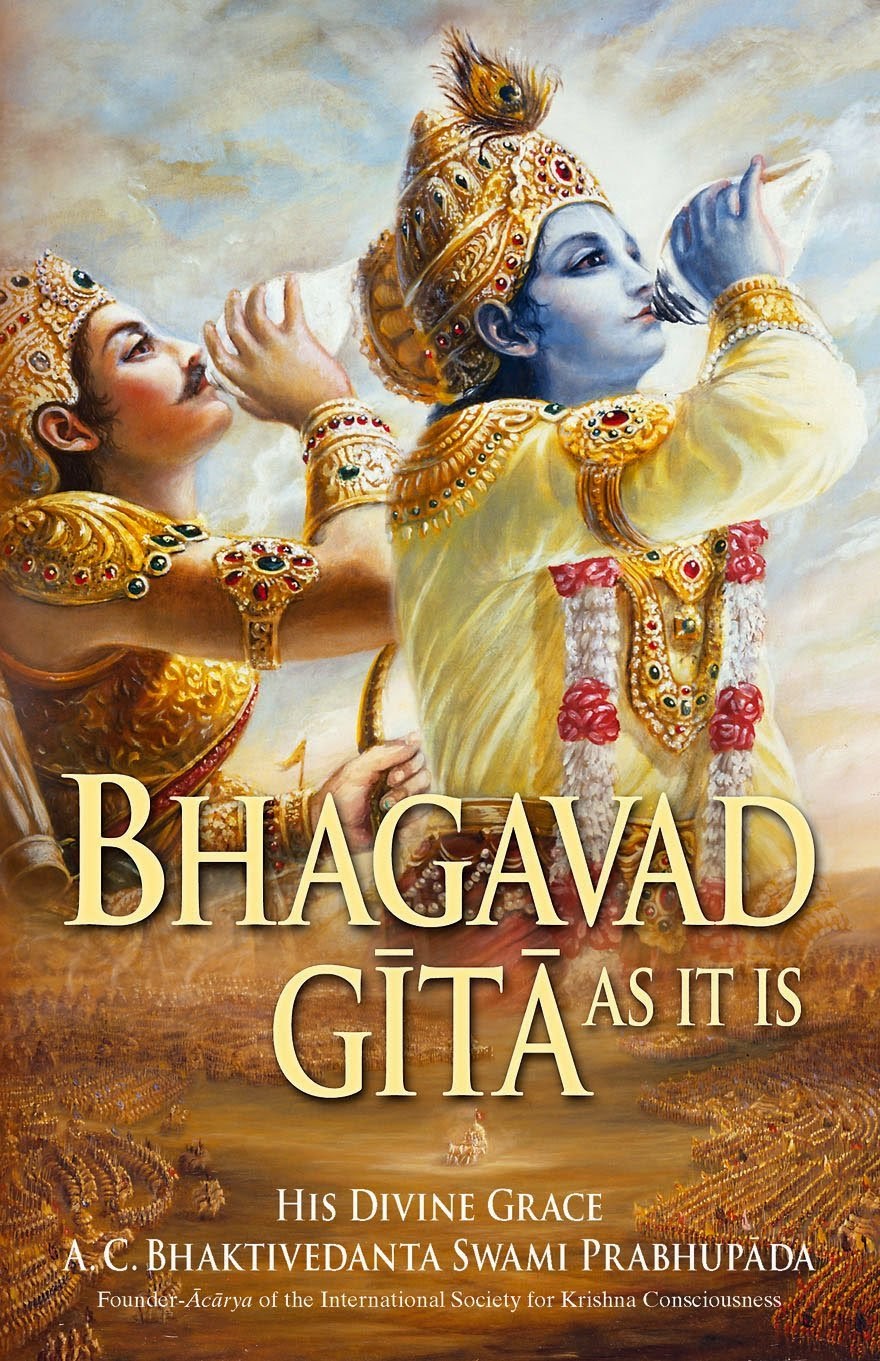
Why Bhagavad Gita is called as a Yoga Shastra or Sacred scripture of Yoga

Bhagavad Gita is called a yoga-shastra, because yoga is taught in it. In Fact, the name of all eighteen Chapters ends with word Yoga. But, the word Yoga, I am not implying the most common misnomer or exercises for the body. The word Yoga is perhaps the most widely misunderstood term and most of the times people consider that doing some postures, controlled breathing and the body and generally practiced for the physical health. I also heard many other terms like, Hot Yoga and even Hip hop Yoga. So going with what most people generally think Yoga is - Physical exercise and breathing is actually a part of Astanga Yoga, which involves controlling the mind and following the Asta angas or eight limbs like, Yama, Niyama,Asana, Pranayama,Pratyahara, Dharana,Dhyana, Samadhi.Then, apart from Astanga Yoga, there are other yogas explained in Gita, which are like Karma Yoga - Yoga of work and renunciation, Jnana Yoga - Yoga of knowledge, Bhakti Yoga - Yoga of devotional service. 
The word “yoga” is used 78 times in the Bhagavad Gita, Including variants like “yogi” (found 28 times) and yukta(found 49 times),it appears 155 times. The word yukta which means connected. Yogi is one who practices yoga, Yukta is one who is connected(with the Supreme God).
The total number of Chapters in Bhagavad Gita is 18 and the number of verses is 700. Thus, 20% of Gita's verses have the word yoga or its related forms. Apart from direct mention of the word Yoga, Lord Krishna talks about Yoga, what is a Yoga, who is a yogi etc in number of verses. Just to give you a feel, I have given below a list of few verses from initial chapters of Bhagavad Gita.
Bg 2.48 — Perform your duty equipoised, O Arjuna, abandoning all attachment to success or failure. Such equanimity is called yoga.
Bg 2.50 — A man engaged in devotional service rids himself of both good and bad reactions even in this life. Therefore strive for yoga, which is the art of all work.
Bg 4.28 — Having accepted strict vows, some become enlightened by sacrificing their possessions, and others by performing severe austerities, by practicing the yoga of eightfold mysticism, or by studying the Vedas to advance in transcendental knowledge.
Bg 4.42 — Therefore the doubts which have arisen in your heart out of ignorance should be slashed by the weapon of knowledge. Armed with yoga, O Bhārata, stand and fight.
Bg 5.4 — Only the ignorant speak of devotional service [karma-yoga] as being different from the analytical study of the material world [Sankhya]. Those who are actually learned say that he who applies himself well to one of these paths achieves the results of both.
Bg 6.2 — What is called renunciation you should know to be the same as yoga, or linking oneself with the Supreme, O son of Pandu, for one can never become a Yogi unless he renounces the desire for sense gratification.
Bg 6.3 — For one who is a neophyte in the eightfold yoga system, work is said to be the means; and for one who is already elevated in yoga, cessation of all material activities is said to be the means.
Bg 6.4 — A person is said to be elevated in yoga when, having renounced all material desires, he neither acts for sense gratification nor engages in fruitive activities.
Bg 6.11-12 — To practice yoga, one should go to a secluded place and should lay kuśa grass on the ground and then cover it with a deerskin and a soft cloth. The seat should be neither too high nor too low and should be situated in a sacred place. The yogī should then sit on it very firmly and practice yoga to purify the heart by controlling his mind, senses and activities and fixing the mind on one point.
Bg 6.17 — He who is regulated in his habits of eating, sleeping, recreation and work can mitigate all material pains by practicing the yoga system.
Bg 6.18 — when the yogi, by practice of yoga, disciplines his mental activities and becomes situated in transcendence – devoid of all material desires – he is said to be well established in yoga.
Bg 6.20-23 — In the stage of perfection called trance, or samadhi, one’s mind is completely restrained from material mental activities by practice of yoga. This perfection is characterized by one’s ability to see the Self by the pure mind and to relish and rejoice in the Self. In that joyous state, one is situated in boundless transcendental happiness, realized through transcendental senses. Established thus, one never departs from the truth, and upon gaining this he thinks there is no greater gain. Being situated in such a position, one is never shaken, even in the midst of greatest difficulty. This indeed is actual freedom from all miseries arising from material contact.
Bg 6.24 — One should engage oneself in the practice of yoga with determination and faith and not be deviated from the path. One should abandon, without exception, all material desires born of mental speculation and thus control all the senses on all sides by the mind.
Bg 6.28 — Thus the self-controlled yogi, constantly engaged in yoga practice, becomes free from all material contamination and achieves the highest stage of perfect happiness in transcendental loving service to the Lord.
Bg 6.33 — Arjuna said: O Madhusūdana, the system of yoga which You have summarized appears impractical and unendurable to me, for the mind is restless and unsteady.
Bg 6.42 — Or [if unsuccessful after long practice of yoga] he takes his birth in a family of transcendentalists who are surely great in wisdom. Certainly, such a birth is rare in this world.
Bg 6.47 — And of all yogi, the one with great faith who always abides in Me, thinks of Me within himself and renders transcendental loving service to Me – he is the most intimately united with Me in yoga and is the highest of all. That is My opinion.
(Translation of the Verses by His Divine Grace Srila Prabhupad – Bhagavad Gita As it is.


Thus by the sheer number of times, the word Yoga being repeated and the essence of the teachings of Gita, we can understand that Bhagavad Gita is a Yoga Shastra or a scripture that endows one with knowledge of Yoga.